Logistics Company Website Design Best Practices: Build Credibility and Win Contracts in Minneapolis
For logistics companies in Minneapolis, your website is your digital dispatch center. Shippers, brokers, and supply chain managers in the Twin Cities vet 3PLs, freight carriers, and warehouses online before they ever request a rate. If your site looks outdated or thin on details, you lose the contract before the first conversation.
Here’s how logistics companies improve credibility and generate qualified B2B leads with professional website design.
1. Design for Decision-Makers, Not Truckers
Your audience is procurement managers, VPs of supply chain, and manufacturers — not drivers. Your site should speak their language: reliability, capacity, and risk reduction.
Clear Value Prop Above the Fold: In 5 seconds, state what you move and where. “Asset-Based LTL + Warehousing Serving Minneapolis to Chicago” beats “Your Logistics Partner.” Add core capabilities: Cross-Dock, Temperature-Controlled, Last-Mile, E-commerce Fulfillment.
Professional, Not Flashy: Skip stock photos of handshakes and globes. Use real photos of your Minneapolis warehouse, fleet, dock doors, and TMS screens. Corporate buyers want proof, not clichés.
Fast + Secure: Many corporate networks block slow sites. Optimize images, use SSL, and keep load time under 2 seconds. Add “SOC 2 Compliant” or “SmartWay Partner” if applicable — it matters in RFPs.
2. Credibility Signals That Win RFPs
Logistics is high-risk. One missed load costs thousands. Your website must de-risk the decision.
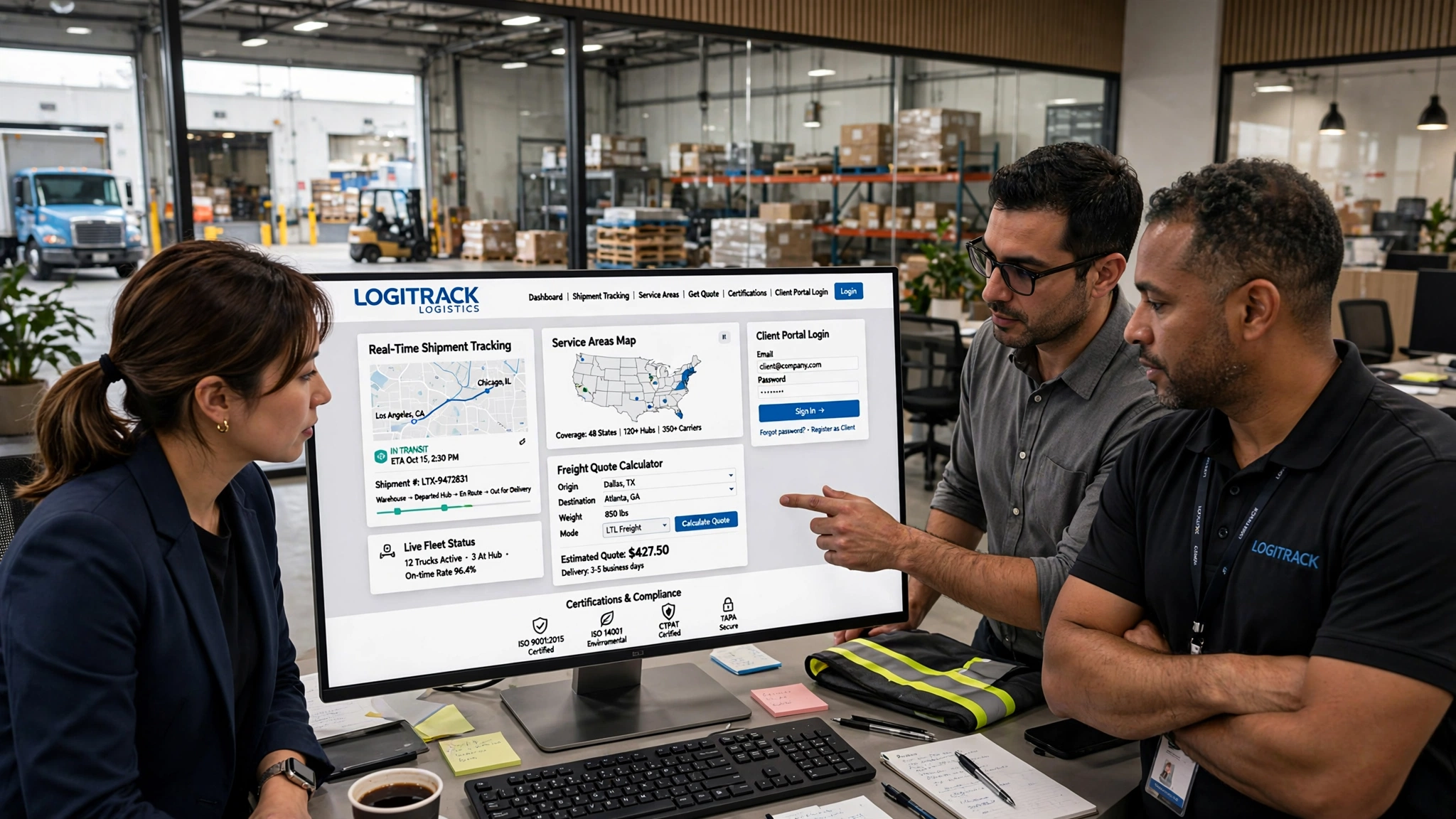
Certifications & Compliance: MC/DOT numbers, C-TPAT, ISO 9001, hazmat, food-grade, FDA registered, bonded warehouse — put them in the footer and on an About/Capabilities page. Make cert PDFs downloadable.
Coverage Maps + Service Area: Show lanes and regions you run. “Daily Service Minneapolis ↔️ Milwaukee ↔️ Detroit” with a map builds confidence for Midwest shippers.
Real-Time or Near-Time Trust Builders: “99.2% On-Time Delivery,” “24/7 Track & Trace,” “50,000 sq ft Warehouse in Brooklyn Park.” Use real data, updated quarterly.
Team + Leadership Bios: Show your dispatch manager, warehouse director, and CEO with logistics experience. “John – 20 yrs, former Target supply chain” tells a shipper who’s running their freight.
3. Service Pages That Pre-Qualify Shippers
Don’t make prospects guess what you do. Dedicated pages improve SEO and sales efficiency.
Dedicated Pages Per Service: Truckload, LTL, Drayage, Warehousing, Fulfillment, Cross-Dock, Final Mile. Each needs scope, equipment list, industries served, and 2-3 case studies.
Industry Landing Pages: “Food & Beverage Logistics Minneapolis,” “Medical Device Warehousing Twin Cities,” “Retail E-commerce Fulfillment.” Shippers search by industry + location.
Tech Stack Section: Name your WMS, TMS, and visibility tools. Integrations with Shopify, NetSuite, or EDI matter to prospects. Add logos and “API Available.”
4. Use Case Studies + Social Proof to Close Deals
Logistics is bought on proof. Show it.
Case Study Format: Challenge → Solution → Result. Example: “Helped St. Paul manufacturer cut 2 days from Midwest transit with Minneapolis cross-dock. Saved $180k/year.” Add metrics.
Client Logos: Feature logos of Minnesota shippers, retailers, and manufacturers you serve, if allowed. Group by industry.
Testimonials from Supply Chain Roles: “Their warehouse team in Minneapolis integrated with our ERP in 3 weeks” from a Director of Ops beats a generic review.
5. Local SEO + Content for B2B Searchers
You’re not chasing clicks. You’re chasing the right 5 people per month.
Location + Service Pages: “3PL Warehouse Minneapolis,” “LTL Freight St. Paul to Chicago,” “Minneapolis Fulfillment Center.” Include unique details: dock doors, racking, rail access, miles to I-94/I-35W.
Google Business Profile: Use “Logistics Service” or “Warehouse” category. Add photos of facility, post about capacity, and list hours for receiving.
Thought Leadership: Blogs like “Avoiding Winter Freight Delays Out of Minneapolis” or “2026 Warehouse Rates in the Twin Cities” rank for niche B2B searches and prove expertise.
Schema Markup: Use Organization, LocalBusiness, and Service schema so Google shows your ratings and services.
6. Make It Easy for Shippers to Start
“Request a Quote” with Freight Details: Let prospects upload a lane list or describe volume. Route to sales, not info@.
Track & Trace Portal Link: If you have one, link it prominently. Even a “Client Login” button signals sophistication.
Dedicated “Carriers” Page: Attract owner-operators and fleets in Minnesota to build capacity. It’s SEO and recruiting in one.
The Bottom Line for Minneapolis Logistics Firms
A professional logistics website acts as your best sales rep. It proves you have the assets, tech, and team to move freight on time in the Upper Midwest. It turns anonymous website visits into RFP invites.
At Optimum Design Tech, we design logistics websites for Minneapolis companies that load fast, showcase capacity, and build credibility with shippers. Because in this industry, trust is the most valuable freight you haul.
Need a website that wins logistics contracts? Contact Optimum Design Tech for a site built for B2B conversion.